




.svg)
.svg)
.svg)
.svg)
.svg)

.svg)

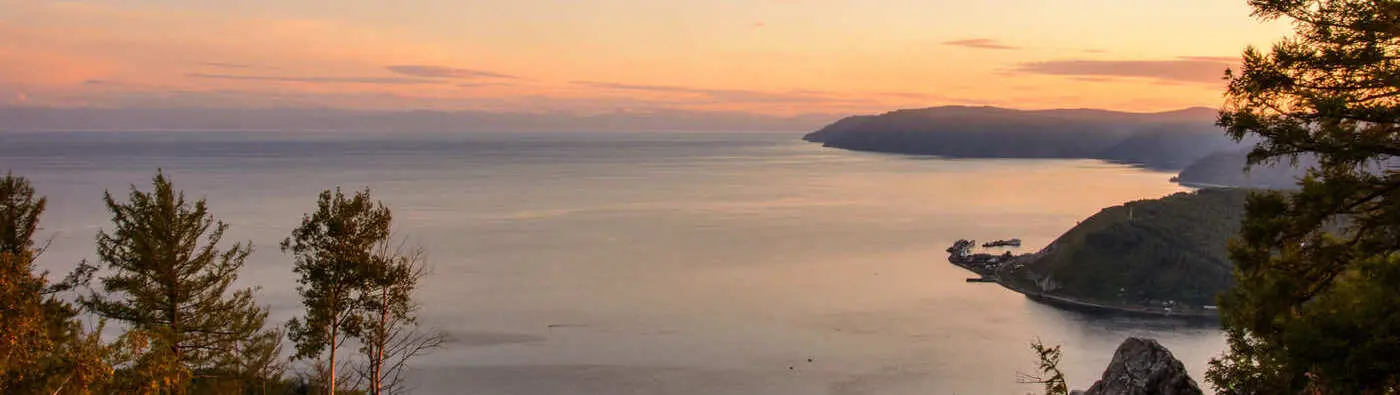


You can begin your exploration of Lake Baikal in Listvyanka. This village, located near Irkutsk, at the source of the Angara River, has been known since the 18th century and was originally called Listvennichnoye – for the abundance of larches growing around it. Anton Pavlovich Chekhov noted the beauty of this area when he visited here in 1890 on his way to Sakhalin. “The shores are high, steep, rocky, wooded; to the right and left you can see capes jutting out into the sea like Ayu-Dag or Tokhtabel in Feodosia. It’s like Crimea,” he wrote to his family. Today, Listvyanka has become a tourist center offering numerous excursions around Lake Baikal, but the village itself also has many interesting things to see.
Chersky stone
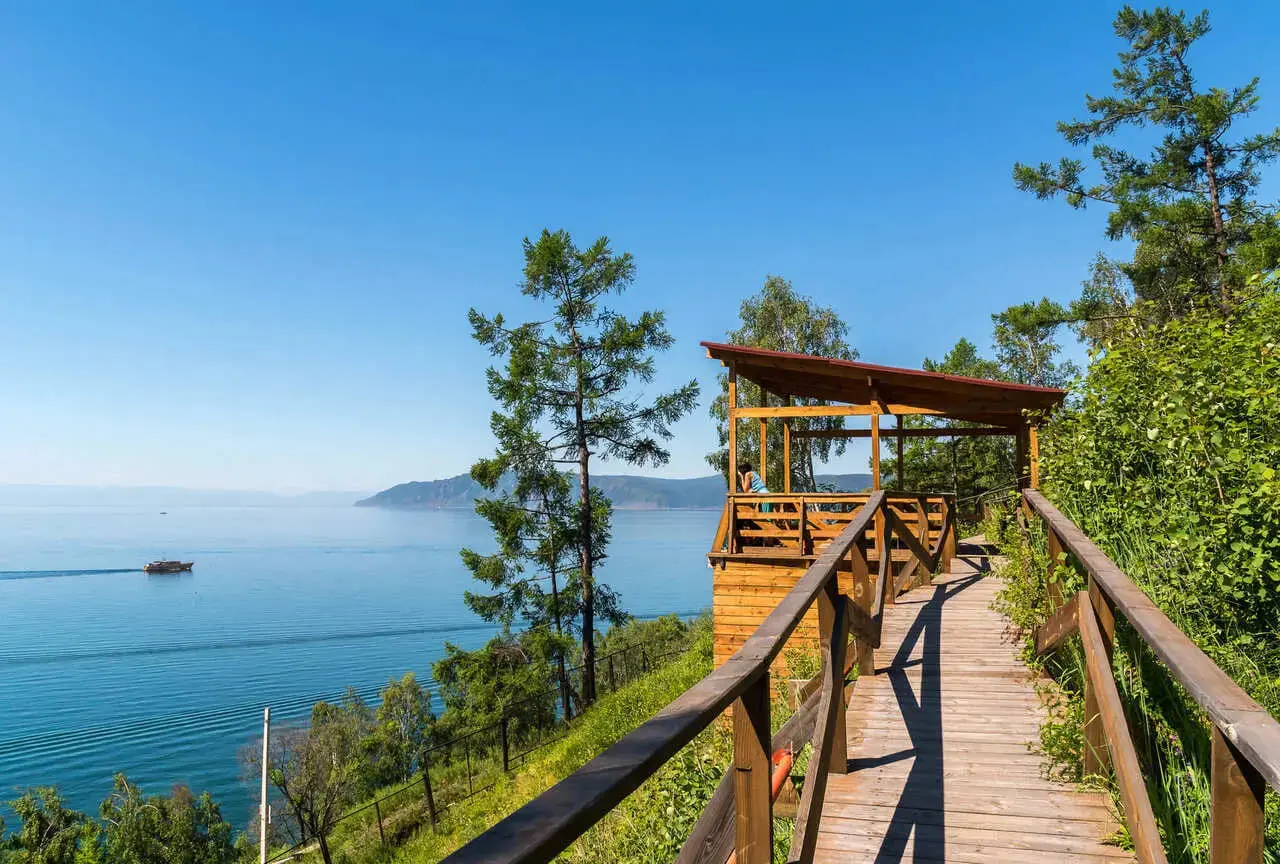
The peak of one of the village's coastal mountains is named after the eminent Siberian explorer Ivan Chérsky. The observation deck located here offers an incredibly beautiful view of the source of the Angara River and the famous Shaman Stone. It is said that in good weather, you can see almost the entire southern coast of Lake Baikal from here. You can reach the summit on foot or by chairlift.
Baikal Museum of the Academy of Sciences
Akademicheskaya St., 1.
In the museum, created on the premises of the Limnological Institute of the Siberian Branch of the Russian Academy of Sciences, you can not only learn many interesting things about the features of this unique lake but also meet its inhabitants. A complex of 9 large aquariums with running water flowing from Lake Baikal from a depth of 400 meters has been created for them. Here you can see taimen, omul, whitefish, Baikal sturgeon, and other fish, as well as Baikal seals – nerpas.
One of the exhibits allows visitors to take a virtual dive to the lake's bottom (to a depth of 1,637 meters) in a replica of the Mir bathyscaphe, which was used to conduct deep-sea exploration of Lake Baikal in 2008–2009. Everything the researchers saw during the dive is broadcast on nine porthole screens, creating a truly immersive experience. Furthermore, visitors can observe Lake Baikal in real time: the screens display a continuous feed from video cameras installed at depths of 5 meters and 200 meters, as well as those located at seal rookeries.
Museum staff are engaged not only in educational but also scientific work: they study Lake Baikal's unique ecosystem. The arboretum, covering 4 hectares, houses a collection of nearly 240 plant species, 50 of which are rare and endangered. Strolling along the wooden paths, you can explore the unique Baikal region's natural environment and admire the stunning views of Lake Baikal from the observation deck.
Seal Aquarium
Gorky Street, 101A.
The Seal Aquarium in Listvyanka opened in 1998 and was the first of two Baikal seal aquariums founded by Evgeny Baranov, a former employee of the Limnological Institute of the Siberian Branch of the Russian Academy of Sciences. In the 1980s, studying Baikal seals was a priority, and the institute's staff collected a wealth of valuable information about their behavior and habitat. Thanks to this, the Irkutsk and Listvyanka seal aquariums have created ideal conditions for these animals. Typically, future performers arrive here as infants: seal pups are brought here after being lost on the ice or rescued from hunters. Seals are considered the most timid seals in the world, but the love and care of the staff can work wonders. Animals truly enjoy interacting with humans, and they enjoy not only repeating familiar routines, but also offering their own versions of new tricks.

St. Nicholas Church
Kulikova Street, 90.
This unique wooden church, according to legend, was founded in the mid-19th century by the merchant Xenophon Sibiryakov. During one of his voyages, he was shipwrecked on Lake Baikal and nearly perished, but was saved thanks to fervent prayer to St. Nicholas, the patron saint of sailors, and his miraculous help. The church was originally built at the site of his rescue, on the banks of the Angara River in the village of Nikola. Later, it was moved to Listvennichnoye, on the shores of Lake Baikal, and in 1956, due to the construction of the Irkutsk Hydroelectric Power Station and the threat of flooding, it was moved again – to the foot of a picturesque mountain in Krestovaya Pad. Both the church itself and the surrounding area are extraordinarily beautiful. In 1974, the film "The Captivating Star of Happiness," about the Decembrists, was shot here.
Baikal Astrophysical Observatory
Partizanskaya St., 29.
The Baikal Astrophysical Observatory, a department of the Institute of Solar-Terrestrial Physics of the Russian Academy of Sciences, covers an area of over 50 hectares. The local microclimate provides excellent observation conditions: 224 sunny days a year and high atmospheric transparency above the lake. Solar observations are conducted using unique telescopes developed by the institute's staff. During a nighttime excursion, you can observe the surface of the Moon, Jupiter's moons, Saturn's rings, and star nebulae and clusters. During the day, you can look at the Sun through a hydrogen filter and take a walk to the Large Solar Vacuum Telescope, one of the largest in the world, installed on the top of the hill. The most adventurous can climb the stairs to its 25-meter-high tower, where the observation deck is located, considered the best on the entire southern coast of Lake Baikal.
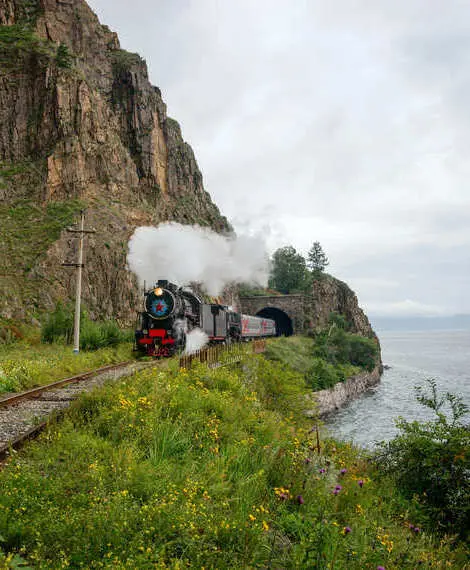
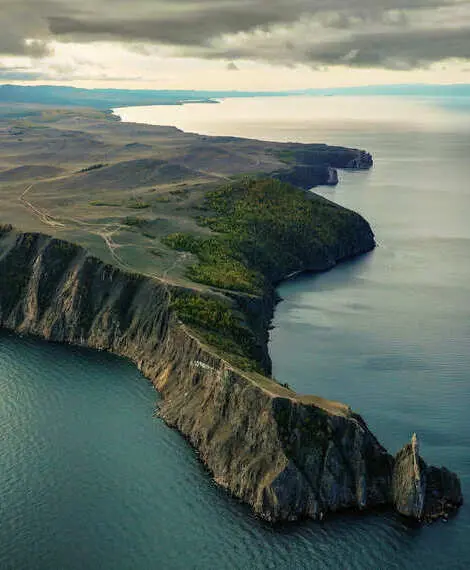
While traveling around Lake Baikal, be sure to also visit Olkhon and Circum-Baikal Railway, and if time permits, admire the amazing nature of Buryatia.